
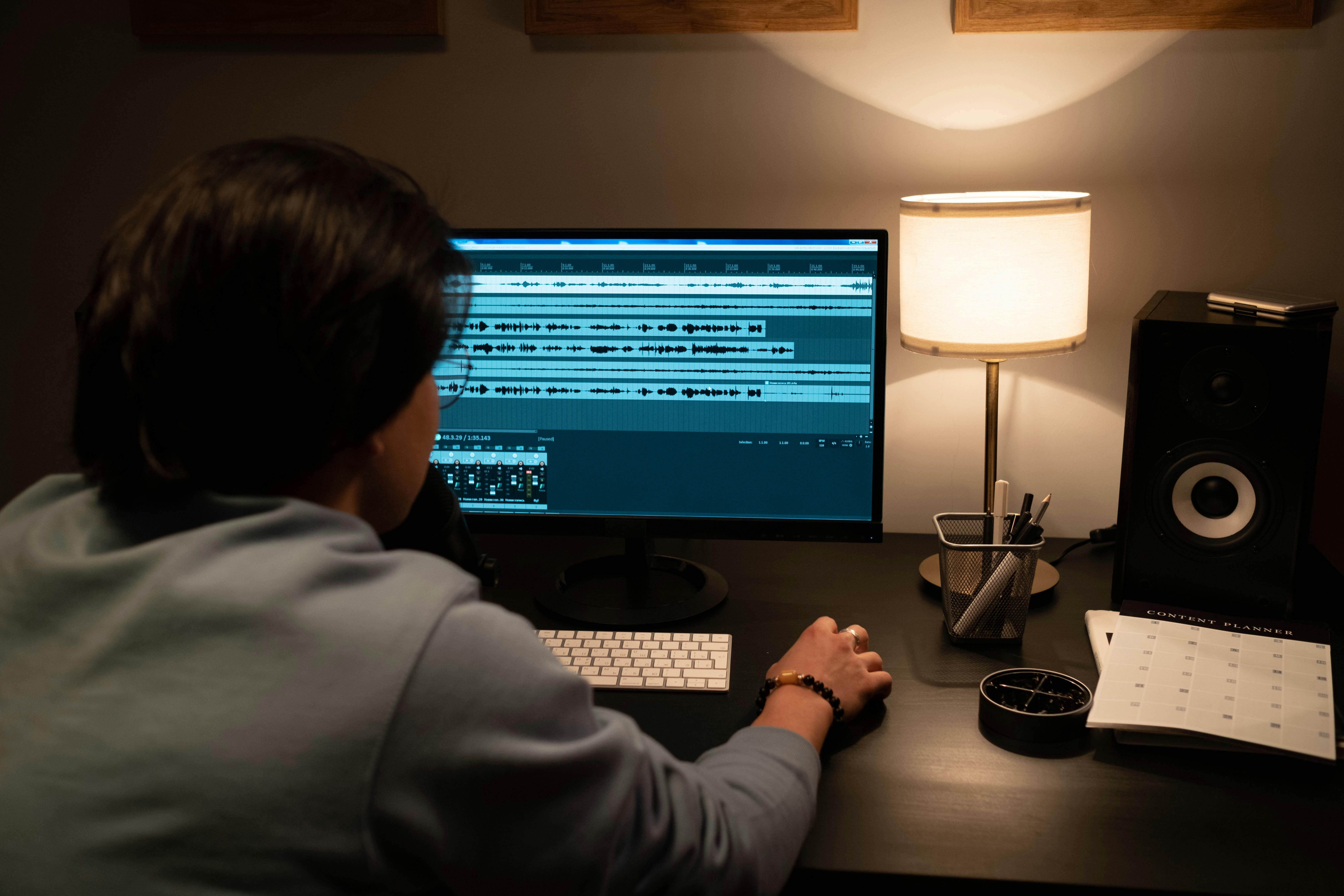
An edit that looks abrupt often becomes invisible once the audio is handled. Sound carries continuity across a cut in a way the picture cannot, and editors exploit that constantly.
Hearing is continuous, seeing is not
Vision already works in jumps. The eye moves in rapid saccades and the brain discards what happens between them, which is part of why cutting between shots is tolerated at all.
Hearing has no equivalent. Sound arrives without interruption, so any sudden change in the audio bed registers as a break in the world rather than as a change of viewpoint.
The practical consequence is that a picture cut over continuous audio reads as a shift in perspective, while an audio cut under continuous picture reads as a mistake.
Room tone is the glue
Every space has a characteristic background sound, and two takes recorded minutes apart will differ subtly in it. A cut between them produces an audible step even when neither is noisy.
Recording a stretch of silence in each location exists to solve this. That tone is laid underneath the whole scene so the background stays constant regardless of how the dialogue is assembled.
Where it is missing, editors extend tone from the longest available take, which is why an apparently trivial recording task on set has a disproportionate effect on the finished scene.
Leading with sound softens the join
Bringing the audio of the next shot in before the picture changes gives the viewer advance notice of the move, so the visual cut arrives as a confirmation rather than a surprise.
Holding the previous audio briefly over the new picture does the same in reverse, tying the shots together by overlapping their soundscapes across the boundary.
Both techniques stagger the transition so that picture and sound do not change at the same instant, which is the moment a cut is most conspicuous.
Music sets a grid the picture can join
A continuous music bed imposes a rhythm, and cuts placed against it feel intentional because the viewer can hear the structure the timing belongs to.
The same footage cut identically without music frequently reads as arbitrary, since nothing external explains why each shot ended where it did.
Where the technique stops working
Sound cannot rescue a cut that violates spatial logic. If the audio suggests continuity while the picture places the subject somewhere impossible, the contradiction is more distracting than either problem alone.
Overusing overlaps has a cost as well. A sequence in which every transition is softened loses the ability to land a hard cut, which is the strongest punctuation available.