
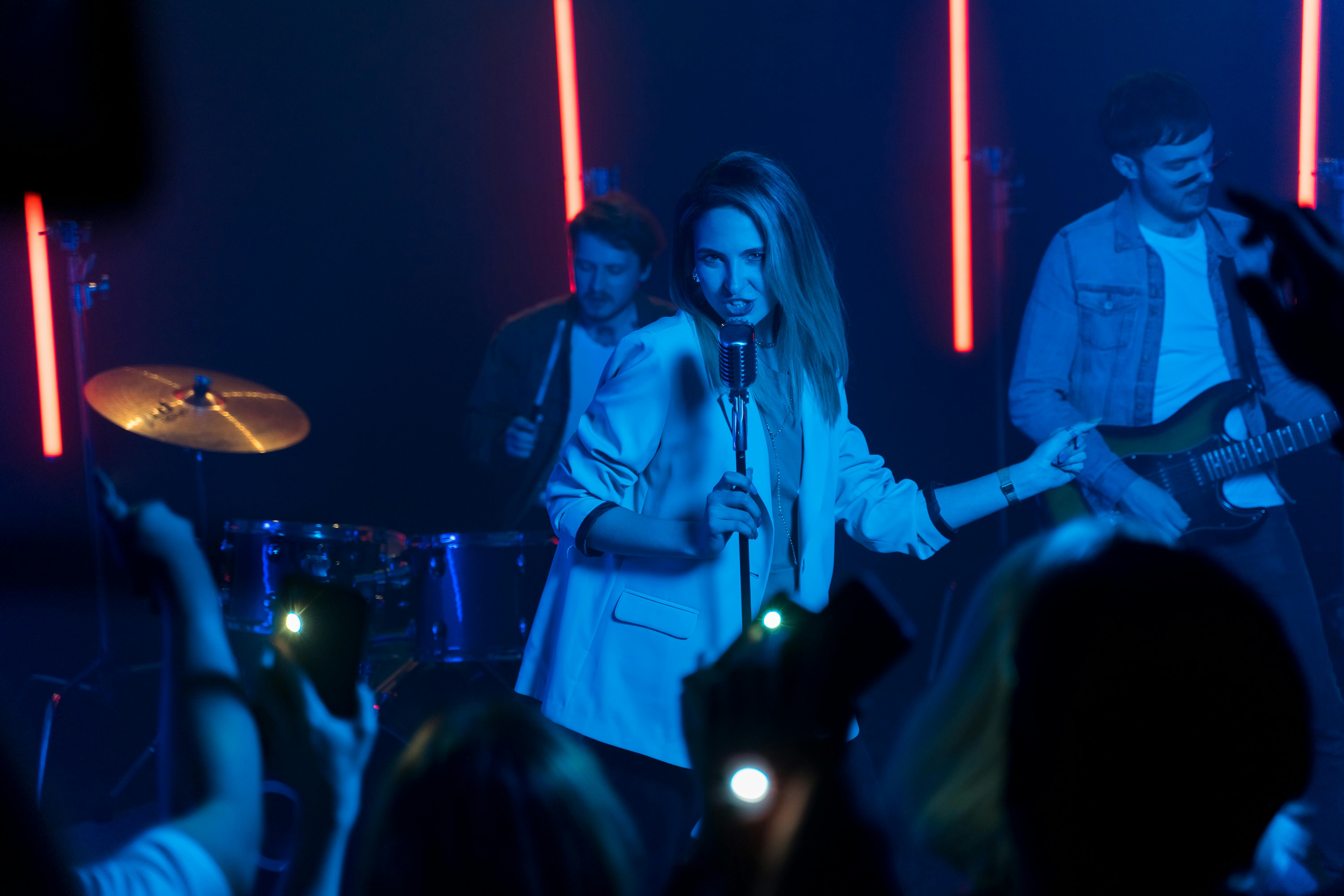
Music video shoots frequently capture the same performance at more than one frame rate. The reason is that slow motion and lip synchronisation are ordinarily incompatible.
Slow motion breaks synchronisation
Footage recorded at a high frame rate and played back at normal speed extends duration, so a performance filmed this way no longer aligns with the track.
Mouth movements slow along with everything else, which is immediately visible and cannot be corrected without returning the footage to its original speed.
This is why straightforward slow motion is generally reserved for shots without visible singing, such as environments, movement and instrumental performance seen from a distance.
Speeding up the playback restores the match
The standard solution is to play the track faster on set by the same factor the camera is overcranked, so the performer mimes at an accelerated rate.
When the footage is slowed to normal speed in the edit, the performance returns to correct timing while everything else in frame moves in slow motion.
The result is a shot where the singer is synchronised to the track and their surroundings, including hair, fabric and any physical action, move at a visibly reduced speed.
The technique has practical limits
Miming accurately at an accelerated speed is difficult, and the difficulty increases sharply with the factor, which is why moderate ratios are far more common than extreme ones.
High frame rates also require considerably more light, since each frame receives a shorter exposure, so the lighting package has to be planned around the fastest shot of the day.
Motion cadence changes as well. Footage captured at a high rate has less motion blur per frame, which reads as slightly unnatural even after being slowed.
Multiple rates in one shoot complicate everything downstream
Clips arrive on the timeline at several different speeds, and each requires its own adjustment before it can be aligned, which makes organised labelling on set essential.
Flicker becomes a risk too, because artificial lighting that appears constant at one frame rate can pulse visibly at another, and the problem is often invisible on a small monitor.
Why the effect is used at all
Slowing everything except the vocal separates the performer from their environment, which is a straightforward way of making a figure appear to occupy a different time from their surroundings.
The technique also survives compression and small screens well, because slow motion reduces frame-to-frame change and therefore compresses cleanly compared with fast movement.